Beyond Tourism: The Historic Legacy of Saptakoteshwar Temple in Goa
Goa is blessed with a rich heritage of history and temples, and among its most significant landmarks is the Saptakoteshwar (Saptakotishwar) Temple at Narve.
Most people visit Goa for its beaches, vibrant party culture, and the experience of savoring fresh seafood with a drink in hand. For many such travelers, Goa’s deep-rooted history, traditions, and spiritual heritage remain largely undiscovered. Those who wish to explore a quieter, more meaningful side of this world-famous destination will truly appreciate the Saptakoteshwar Temple—nestled in serene natural surroundings and steeped in historical significance.
Saptakoteshwar Temple: Setting, Layout and Scenic Charm
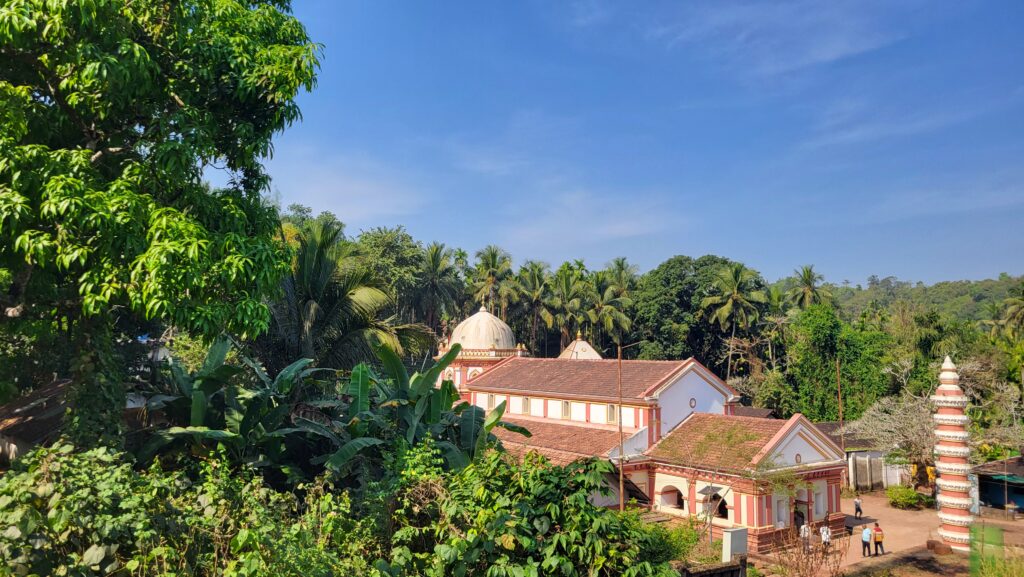
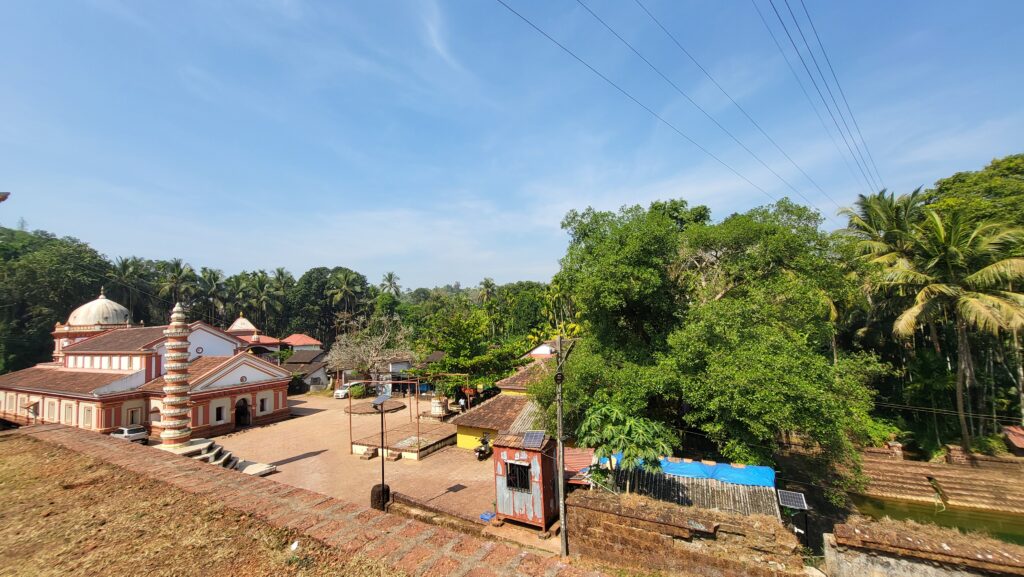
Narve is a small village in Bicholim taluka of North Goa. Situated along the banks of the Chapora River, this picturesque village is surrounded by coconut palms and lush greenery. Tucked slightly below road level on one side, the Saptakoteshwar Temple stands gracefully amidst this serene landscape.
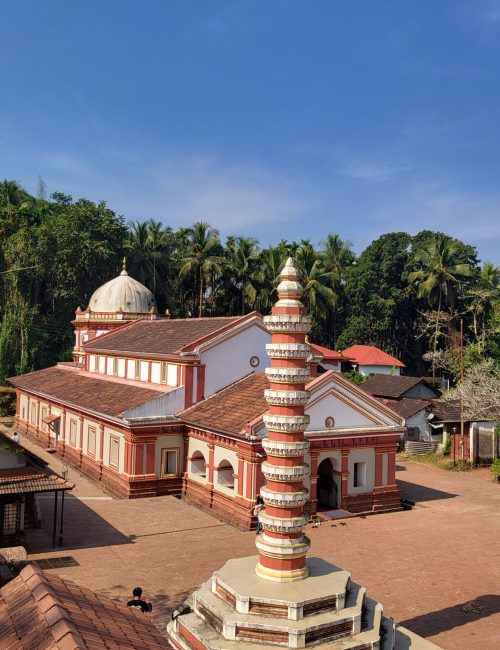
There are two ways to enter the temple. On the right side, a flight of steps leads down to the complex. Even before descending, the panoramic view of the temple and its surroundings is truly captivating. The main shrine, the tall deepstambh (lamp tower) in front of it, the temple pond, and the greenery stretching out behind the temple together create a scene that is hard to take your eyes off.
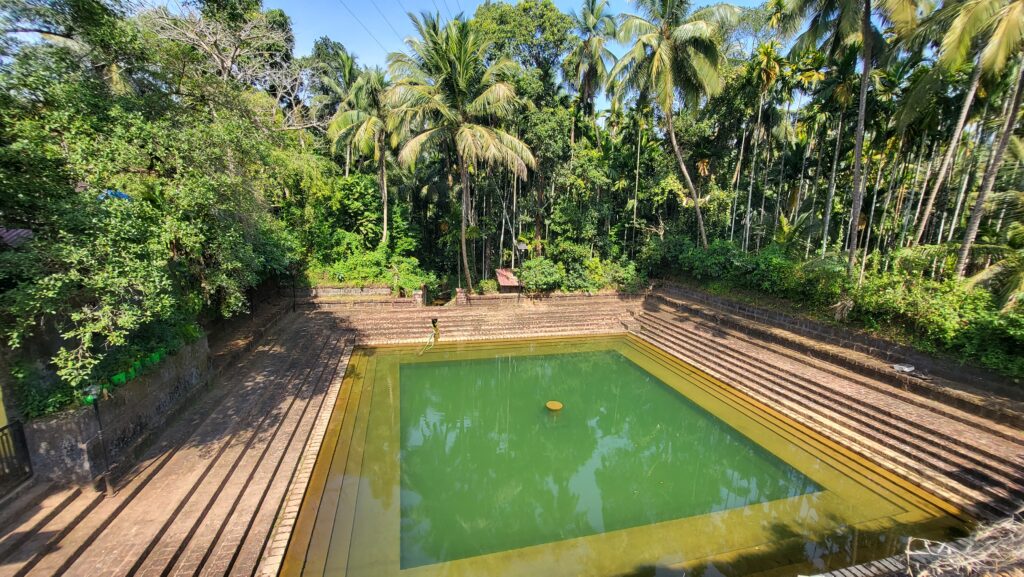
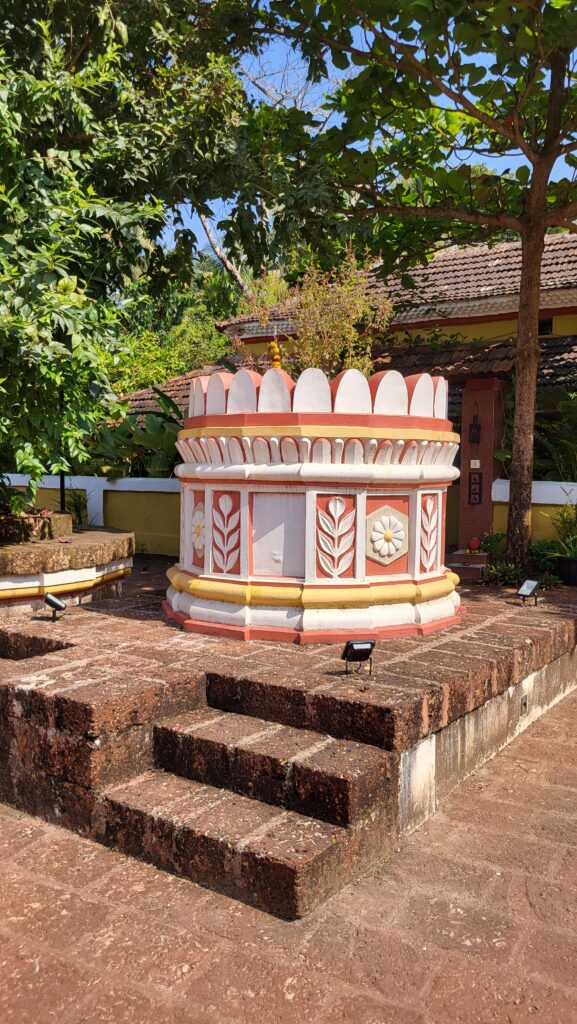
The second approach is from the front, along a paved road. As you walk in, the temple tank appears on the right, and just beyond it, on slightly higher ground, stands the shrine of Kaalbhairav. In the courtyard rises an eleven-tiered circular deepstambh adorned with sculpted naga motifs, set on a four-tiered octagonal base. In front of it is a small open stage, and to its right stands a beautifully maintained tulsi vrindavan. From here, the temple—built entirely of red laterite stone—comes into full view, framed by a lush green backdrop that instantly draws attention.
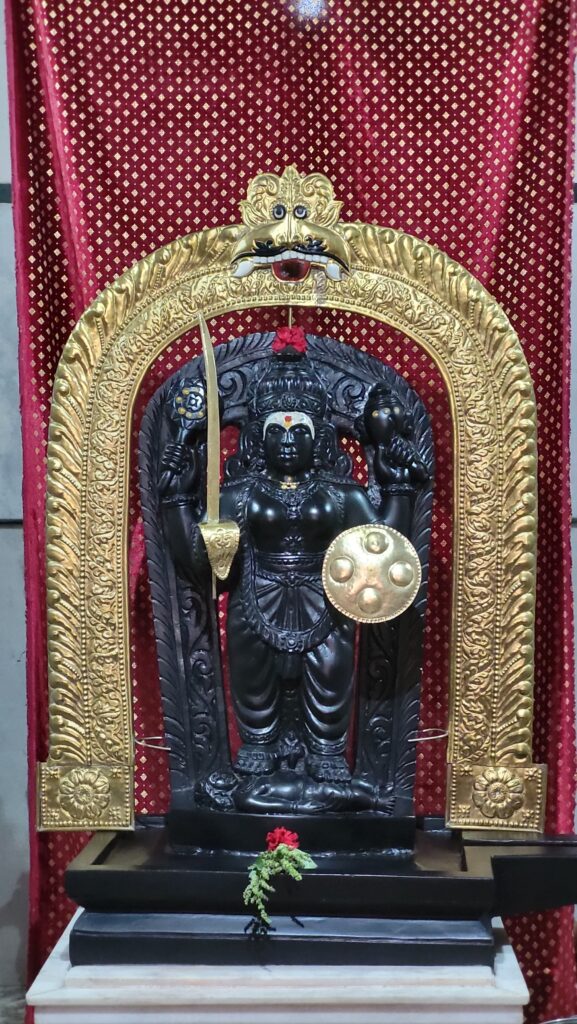
Within the temple grounds itself, on the left side of the main shrine, there is also a small temple dedicated to Arya Bhavani Devi.
Restoration of the Temple by Chhatrapati Shivaji Maharaj
The temple is believed to have been originally built in the 12th century by a Kadamba ruler. Later, during the Muslim and Portuguese rule, it was destroyed. In 1668, Chhatrapati Shivaji Maharaj undertook the restoration of the temple and revived its sacred presence.
Temple Architecture
The temple follows the traditional Goan architectural style, consisting of a mukha mandapa (entrance hall), maha mandapa (main hall), antarala (vestibule), and garbhagriha (sanctum). The structure is topped with a sloping tiled roof. The entrance to the mukha mandapa is arched, and large arched windows are built into the walls on both sides.
The entrance to the maha mandapa is made of stone and also features an elegant arch. Above this doorway is a historic inscription referring to the temple’s reconstruction under Chhatrapati Shivaji Maharaj. It reads: “Shri Saptakotish, in the Shaka year 1590, in the year Kilaka, on Kartik Krishna Panchami, on a Monday, by the command of Shri Shivraj, the construction of the temple began.”
To the left of the entrance stands a striking half-bust statue of Shivaji Maharaj, with a graceful expression and a slightly tilted head, immediately drawing the attention of visitors.
Kaavi Art and Intricate Ornamentation in the Maha Mandapa
From here, two steps lead up into the maha mandapa, from where devotees can have a clear view of the Shiva lingam in the sanctum. The hall is tall and spacious, designed in the traditional Goan architectural style. A series of broad pillars stand slightly away from the outer walls, supporting a graceful system of arches.
One of the most striking features of the temple is the exquisite Kaavi artwork adorning the walls, pillars, and arches. Created using natural pigments and traditional techniques, these intricate designs reflect Goa’s rich artistic heritage and add a distinct charm to the sacred space.
Unique Shiva Lingam of the Saptkoteshwar Temple
The temple ceiling features glass lamps suspended at the center to illuminate the hall. The tall façade wall of the antarala (vestibule) is beautifully decorated with traditional Kaavi artwork. On either side of the entrance, within square niches, are stone idols of Lord Ganesha and Lord Hanuman. Above the doorway, a large wooden shrine houses an image of Shri Saptakoteshwar, while directly in front of the entrance stands a stone idol of Nandi.
The Shiva lingam in the sanctum, placed at ground level, is distinct from those seen in most other temples. Typically, a Shiva lingam consists of three parts — the Brahma-bhaga, Vishnu-bhaga, and Shiva-bhaga — of which the Brahma and Vishnu portions remain below ground level. However, at this temple, both these portions are visible above the surface, making the lingam here truly unique.
The temple features a tall shikhara built in the traditional Goan architectural style, adding to its graceful and distinctive appearance.
A Rare Cave-Style Sanctum
The most remarkable feature of this temple is its sanctum. It is carved in the form of a cave within a massive rock. In the upper section of the same rock, a chamber has also been carved, complete with steps leading up to it. While performing pradakshina (circumambulation), these steps can be seen at the rear of the sanctum.
During the recent restoration of the temple, a glass wall was installed on the outer side of the rear wall of the sanctum, allowing visitors to view and appreciate this unique rock-cut structure more closely.
The Legend Behind the Name ‘Saptakoteshwar’
There is a popular legend that explains how the deity came to be known as Saptakoteshwar. The name is derived from two Sanskrit words — Sapta (seven) and Koti (crore or ten million). The story reveals how these words became part of the divine name.
It is believed that at the confluence of the sea and the Panchganga River, seven great sages performed intense penance for seven crore years in devotion to Lord Shiva. Pleased by their unwavering austerities, Lord Shiva appeared before them and granted them a boon. The sages humbly requested that he reside at the very place where they had meditated, and remain there for seven crore years. Lord Shiva accepted their request, and from that time, he came to be known as Saptakoteshwar.
As the Lord of the seven sages, he is also revered by the name Saptanath.
The Original Site of Saptakoteshwar: Divar Island
The original abode of Saptakoteshwar was at Narve on Divar Island in Goa. In the Sahyadri Khanda of the Skanda Purana, this island is referred to as Deepvati. It is a small island located in the Mandovi River, to the north of Tiswadi.
Saptakoteshwar was the family deity (kuladevata) of the Kadamba dynasty, and the Kadamba rulers held deep faith and devotion toward this sacred shrine.
Safeguarding the Shivling and the Rise of New Narve
When Narayanrao Suryarao Desai, a nobleman under the Adilshahi rule, learned about the desecration of the temple, he acted swiftly. One night, he secretly sent his soldiers to the island. They carefully retrieved the Shivling and brought it away in secrecy.
In the dense forests near the village of Hindale, a sanctum was carved into a rock within a secluded valley, and the Shivling was reinstalled there. Over time, this settlement came to be known as New Narve, marking the beginning of a renewed chapter in the temple’s history.
Chhatrapati Shivaji Maharaj’s Goa Campaign and the Temple’s Revival
During the Portuguese rule, religious oppression in Goa began to intensify. In response, Chhatrapati Shivaji Maharaj launched a campaign against the Portuguese in 1667 to assert his strength and protect local communities. For three days, his forces swept through the Bardez region, capturing around 300 prisoners and seizing wealth worth 150 lakh hons, before proceeding to Bicholim.
During this time, Shivaji Maharaj visited the village of Narve. After taking darshan of Shri Saptakoteshwar, he ordered the restoration of the temple, initiating a significant revival of this sacred shrine.
Major Festivals and Celebrations at Saptakoteshwar Temple
Various festivals and religious celebrations are observed at the temple throughout the year with great devotion and enthusiasm. Among them, Mahashivratri and Gokulashtami are the most significant. According to a popular legend, the day Lord Shiva appeared before the seven sages was Gokulashtami. For this reason, the festival is celebrated here with special fervour. On Mahashivratri as well, thousands of devotees gather to seek the blessings of Shri Saptakoteshwar.
In addition, the temple celebrates a unique Kiranotsav, similar to the one at the Mahalaxmi Temple in Kolhapur. Every year on 21st June, at sunrise, the rays of the sun fall directly upon the Shiva lingam, illuminating it beautifully. This breathtaking sight draws countless devotees who assemble to witness the divine moment.
How to Reach Saptakoteshwar Temple
Saptkoteshwar temple is located approximately 22 to 25 km from Panaji and around 8 km from Bicholim. Buses operated by Kadamba Transport are available from the Bicholim bus stand to reach the temple. Private vehicles can go directly up to the temple’s parking area.
Scientific Restoration and Cultural Revival of the Saptakoteshwar Temple
This beautiful Saptakoteshwar Temple in Goa was recently restored by the Goa State Directorate of Archaeology. The conservation project began in 2019 and was successfully completed in 2023.
The restoration was carried out in a thorough and scientific manner, carefully preserving the temple’s original structure while retaining its historical character. Traditional techniques such as the revival of Kaavi art and the use of lime plaster were employed to maintain authenticity. The main objective of the project was to restore the original form of the Kadamba-era cave temple and highlight its rich heritage value.
The renovated temple was formally inaugurated in February 2023. Recognized as a symbol of Goa’s spiritual and cultural revival, this historically significant temple continues to attract devotees of Lord Shiva, tourists, and countless history enthusiasts alike.